
The Klaviyo Alternative Nobody Saw Coming
Klaviyo's bill grows with your list. Here's how the top email and SMS alternatives compare for scaling Shopify brands.

Written by Craig Langan
The best Klaviyo alternative for a scaling Shopify brand with more than $1M of annual sales depends on your stack. Privy bundles list growth tools, email, and SMS in one bill starting at $30/month. Omnisend covers budget multichannel, Flodesk suits design-first lightweight stores, and Klaviyo is there for advanced, complex use cases.
Key Takeaways
- Klaviyo bills on active profiles, so cost climbs as your list grows — about $150/month at 10,000 contacts, before SMS.
- Privy bundles popups, email, and SMS in one bill from $30/month, billed on mailable contacts (not every stored profile).
- The best fit depends on your stack: Omnisend for budget multichannel, Flodesk for design-first stores, Klaviyo for advanced, integration-heavy needs.
Brands chasing eight figures are taking a closer look at their retention marketing stack. They're all asking the same question: Is Klaviyo still the best fit for where we're headed?
I run sales at Privy, so I'll admit I’m biased. But I spend my days talking to merchants across Shopify, BigCommerce, and more who have outgrown their initial build and are ready to scale efficiently.
A few years ago, founders asked what they should add to their tech stack. Today, they're asking how they can be more efficient. That desire for powerful simplicity is exactly why they're looking to switch from Klaviyo.
Why More Merchants Are Looking at Klaviyo Alternatives
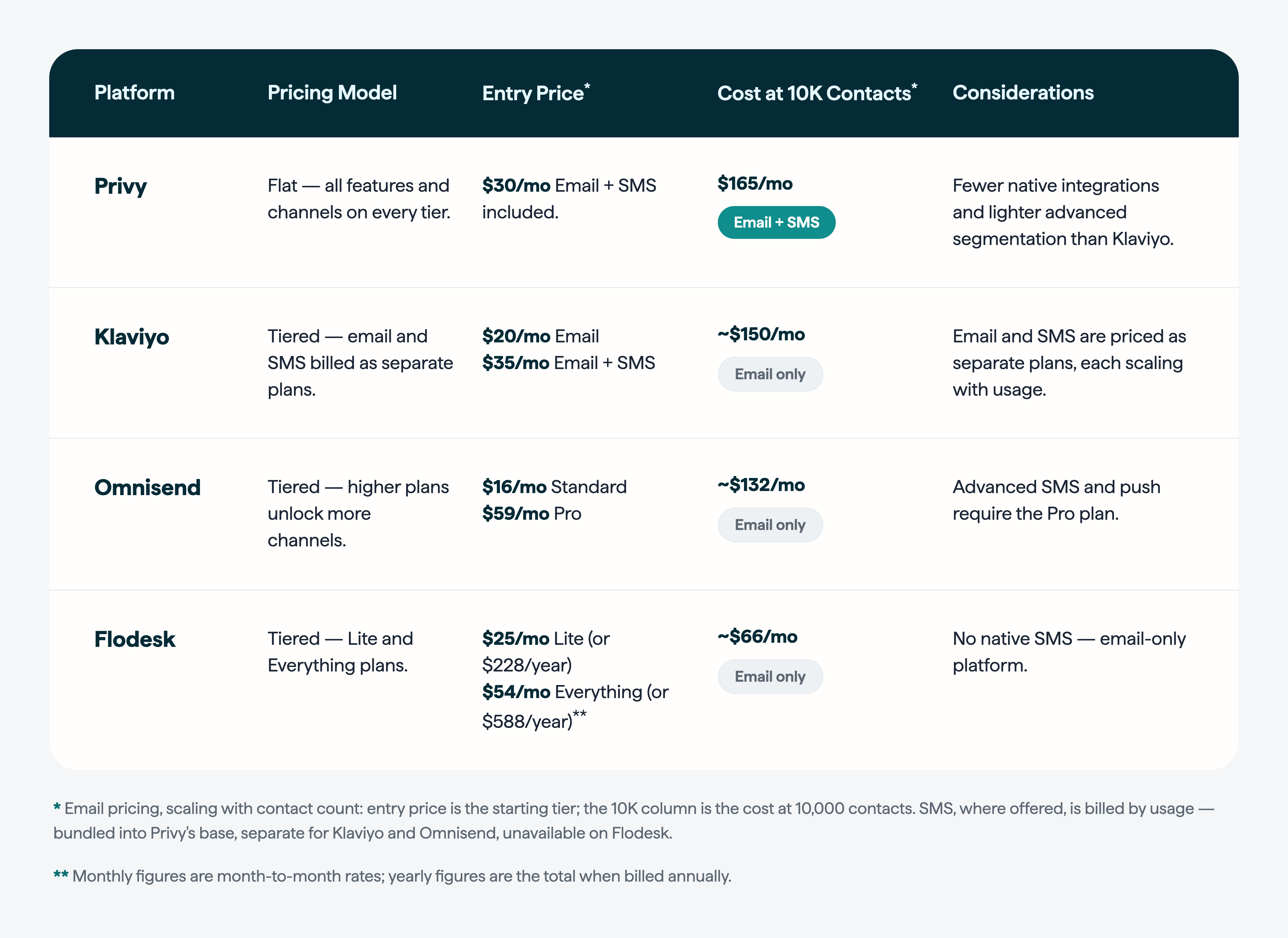
Merchants leave Klaviyo over cost, not always quality. Klaviyo is a great product. But it bills on active profiles, not just who is mailable, so cost rises as your engaged and unengaged list grows — about $100/month at 5,000 contacts and $150/month at 10,000, before SMS.
As brands grow, lists grow. Then SMS gets layered on. Then an advanced popup tool. Then an agency for emails, then another for design.
At some point you tally the whole stack and ask a fair question: Are we seeing a return on this investment?
This is a healthy exercise for any growing business, because a growth mindset requires capital for every aspect of the business.
The brands chasing $10M are more disciplined than they used to be. They evaluate every vendor through efficiency, not feature-list length. They're looking for a platform that helps them meet their goals without unnecessary cost or complexity.
Quick-Glance Comparison: Klaviyo Alternatives for Shopify
Here's the honest side-by-side. The best fit balances entry price, channel coverage, and how gracefully cost scales for a lean team. Privy leads on all-in-one value for growing brands.
The others each win a narrower lane. And Klaviyo still wins when it comes to depth: more native integrations, advanced segmentation, and a bigger app ecosystem. Depth can be worth the premium if you have a dedicated marketer to use it.
Most Growing Shopify Brands Still Run Lean
People outside ecommerce underestimate how lean these teams are. A brand doing several million a year doesn't necessarily have a big retention team. The founder is often still hands-on, and one person usually owns email, SMS, campaigns, and promos all at once.
That matters because every platform takes time to learn and maintain.
When you're prepping for BFCM or trying to hit aggressive growth targets, complexity gets expensive. So merchants want fewer moving pieces — not fewer capabilities.
The Alternative Most Merchants Don't Expect
For years, Privy was known as the popup company. That's fair. We built our reputation helping Shopify stores grow their email lists and capture more leads.
But while most people still thought of us that way, we were building something much bigger.
The comparison that comes to mind is the New York Knicks.
The Knicks just won the 2026 NBA Championship which is their first championship in 53 years. It wasn't because they landed one superstar and suddenly became contenders overnight. Year by year, they added the right pieces, built a cohesive team, and created a system that consistently produced winning basketball.
At some point, people stopped looking at them as a feel-good story and started recognizing them as one of the best teams in the league.
In a lot of ways, that's been Privy's trajectory.
While attention was focused on the bigger names in email and SMS, we kept building. What started as a popup platform evolved into a complete retention marketing platform that combines popups, email, and SMS in one place.
Today, many merchants are discovering that the company they remember as a popup tool has become a legitimate alternative for brands that want to simplify their stack without taking on enterprise-level costs.
That's usually the moment I hear some version of the same thing:
"I didn't realize Privy did all of this now."
How Privy Has Changed
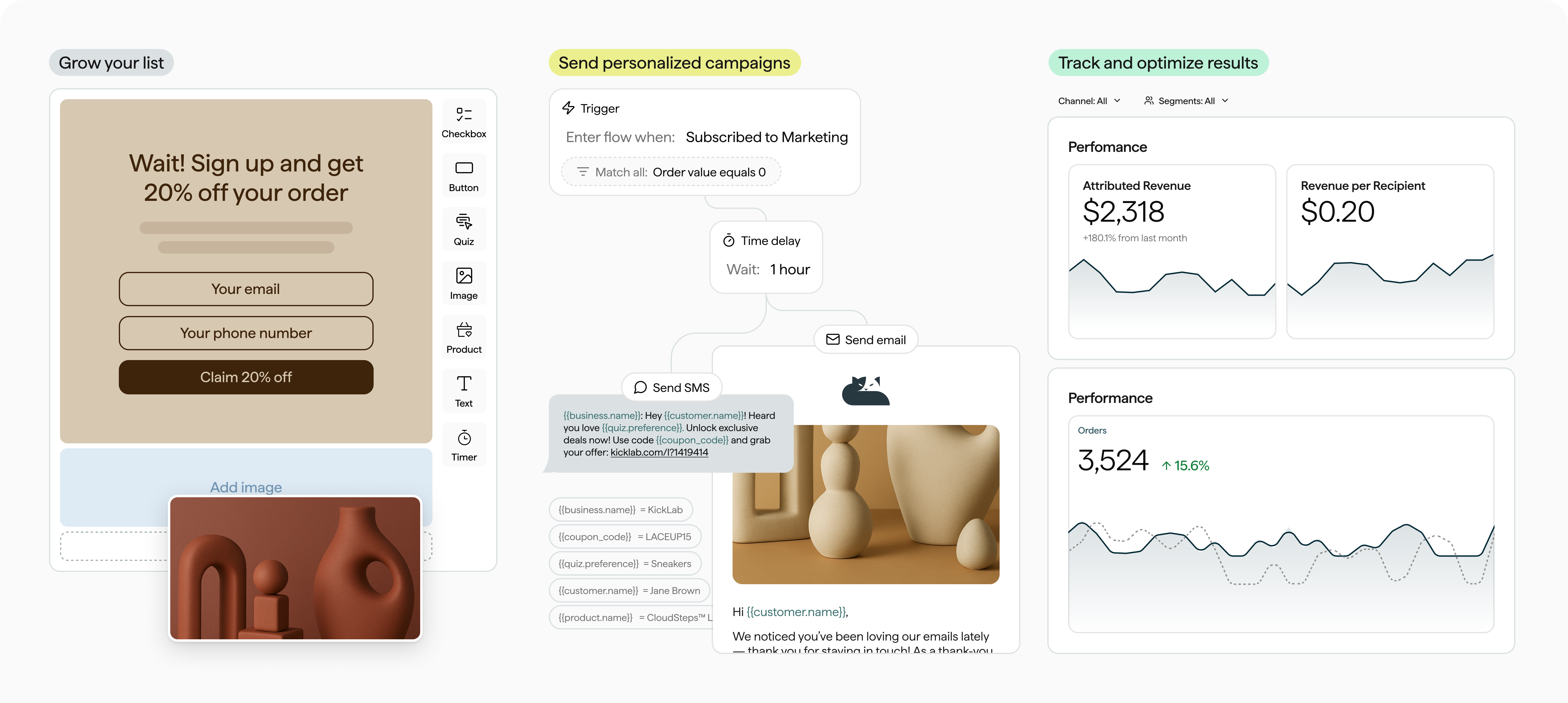
Merchants who haven't looked at Privy in a few years are surprised. What started as a popup tool is now a complete retention solution.
With Privy, brands can build and track:
- Popups and Onsite Conversion
- Email & SMS Campaigns
- Automated Flows
- Customer Segmentation
- Personalized Messages with Integrations
All from one platform; for growing brands, that matters.
Privy's goal isn't to be another tool. Our goal is to help you manage your whole retention strategy — quicker.
Why Pricing Became Part of the Conversation
Pricing is a top reason merchants start looking. Again, that's not a criticism of Klaviyo. It's reality.
As lists grow, software costs grow too, and founders now scrutinize every line.
They ask smart questions:
- Are we paying for capabilities we use?
- For contacts we can actually market to?
- Could we consolidate tools into one platform?
- Are we getting more efficient as we grow?
We built Privy's pricing around growing ecommerce brands. Email and SMS starts at $30/month.
We also bill on mailable contacts — the audience you can actually reach, not every profile in the database. Email still returns an average $36–$40 per $1 spent industry-wide, and you capture that without enterprise-tier pricing.
What Other Platforms Offer
A few other names come up when you search email, SMS, popups, etc. They're solid players — just not built to carry a brand through BFCM.
Flodesk suits design-first solopreneurs. It retired its flat unlimited plan for new members on December 2, 2025; Lite now starts at $25/month, Everything at $54/month for up to 1,000 subscribers. Gorgeous templates, light on analytics.
Omnisend covers email and SMS across one platform, with a free plan to start; advanced SMS and push features require the higher Pro tier — from ~$16/month Standard, $59/month Pro.
Shopify Email is the easiest place to start — it’s built into your Shopify admin, with the first 10,000 emails free each month and $1 per 1,000 after that. But it’s email-only with basic automation, so growing brands outgrow it quickly.
Mailchimp is the best-known general-purpose option, but it’s not ecommerce-native and bills for unsubscribed and duplicate contacts. Entry is $13/month, though real costs run higher.
ActiveCampaign brings powerful automation and a built-in CRM from $15/month. It’s built for sales-funnel-heavy teams, so it gets complex fast.
Brevo (formerly Sendinblue) bills by emails sent, not contacts, from $9/month. Good for high-volume sending, lighter on ecommerce depth.
Why This Matters Heading Into BFCM
The timing isn't random. As we near Q4, merchants scrutinize the systems they rely on. Nobody wants to enter BFCM wondering if three platforms are syncing — or discover in October they've overpaid for tools they barely use.
The best Q4s usually go to brands that simplify before the holiday rush.
They know where their data lives. They know how their automations work. And they spend less time babysitting software.
The Bigger Shift I'm Seeing
The biggest trend I'm seeing isn't merchants abandoning Klaviyo. It's merchants becoming more intentional.
The brands chasing $10M today are operating differently than they were a few years ago.
They're paying closer attention to profitability. They're scrutinizing software costs. They're looking for opportunities to simplify their operations. And they're evaluating every platform based on the same question:
Is this helping us grow, or is it just adding complexity?
That's why Privy is showing up in more conversations.
Not because we're the newest platform in the market. Not because we're the loudest.
Because while most people still think of Privy as a popup company, we've spent the last several years building a retention platform for growing ecommerce brands.
Now that more merchants are taking a fresh look at their stack, they're starting to notice.
And honestly, that's been one of the most interesting things to watch.
Best For: Pick by Store Economics
Match the tool to your numbers, not the logo. For most fast-growing small to medium business owners running lean, Privy is the highest-value starter — with no enterprise surcharge waiting as you scale. It is the best fit for a lean team that wants one bill, not the right call for every store.
- Best all-around value for growing Shopify brands: Privy — popups + email + SMS, one fair bill.
- Best for design-led solopreneurs: Flodesk — beautiful templates, light analytics.
- Best free-tier starting point: Omnisend — generous free plan, scales gradually.
- Best for brand-new Shopify stores: Shopify Email — free to start, email only.
FAQ
What is the best Klaviyo alternative for a growing Shopify store?
For a lean team that wants popups, email, and SMS in one bill, Privy is the best-value all-in-one option. It bundles popups, email, and SMS in one platform from $30/month and bills on mailable contacts, not stored profiles.
Why does Klaviyo get more expensive as I grow?
Klaviyo bills on active profiles, so cost rises with your engaged and unengaged list — about $100/month at 5,000 contacts and $150/month at 10,000, before SMS.
Can one platform replace separate popup, email, and SMS tools?
Yes. Privy combines popups, email, automated flows, SMS, cart recovery, and segmentation in one platform — letting lean teams consolidate their retention stack before BFCM.
Writen by Craig Langan

Craig Langan is the Vice President of Sales at Privy. He joined Privy when it acquired Emotive in 2025 with the intent to transform their sales team.
You may also like to read
More guides on email, SMS, and list growth for scaling Shopify brands.
The Ultimate Guide to Ecommerce Welcome Emails (With Examples)
From first impressions to first purchases.
SMS Marketing Made Simple: A Beginner’s Guide for Ecommerce
Text marketing, or SMS marketing, is a fast-growing channel for ecommerce brands to engage with subscribers and drive sales. Here's a guide to getting started.
Email Segmentation: A Beginner’s Guide for Ecommerce Brands
Email segmentation is an amazing way to generate sales for your Shopify store. But what is it exactly? Here's what you need to know about getting started.